
 English
 عربى
عربى
Wholesale Color Matching Acoustic Panels


Color Matching Acoustic Panels Manufacturers
-
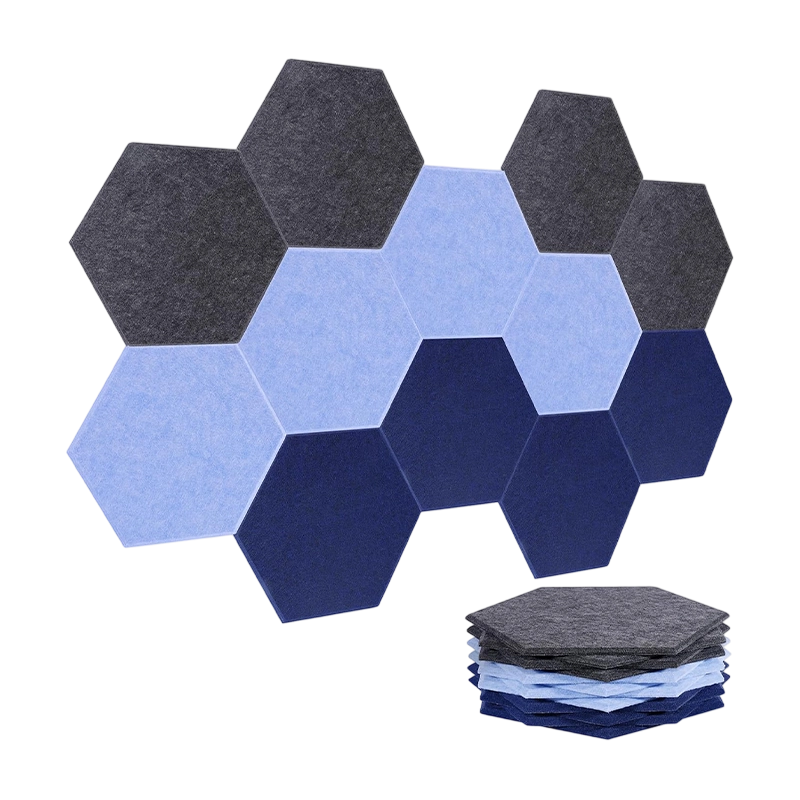

Hexagonal Self-Adhesive Color-Blocking Sound-Absorbing Panels
-
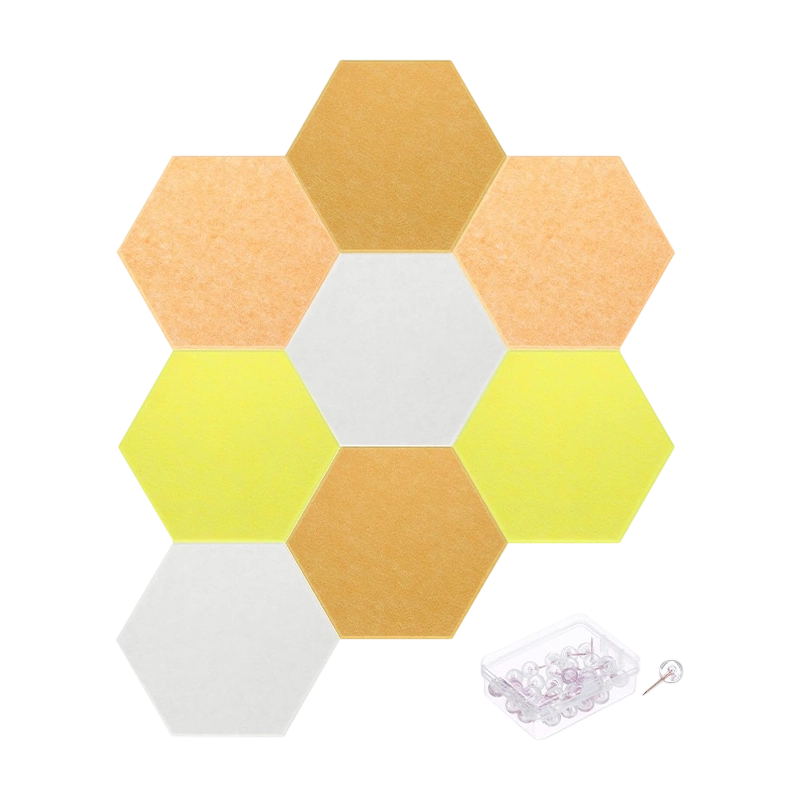
Self-adhesive color-blocking sound-absorbing panels
Color matching acoustic panels combine two or more panel colors into a single curated tile composition, designed to function as decorative acoustic art rather than a purely functional treatment. Each combination is developed by in-house design specialists and precision cut to interlock cleanly, ensuring consistent pattern alignment across multi-tile installations.
The polyester fiber substrate delivers the same reliable broadband sound absorption as standard panels, while the color composition adds a layer of visual interest that reduces the need for additional decorative elements. Popular in creative studios, children's learning environments, hospitality spaces, and lifestyle retail.
Custom color pairings and pattern layouts are available for project and OEM orders.
Changshu Chiheng Decorative Materials Co., Ltd.
We are a professional manufacturer specializing in polyester fiber acoustic materials, dedicated to providing effective, safe, and sustainable sound control solutions for architectural and interior spaces.
With a modern production base covering 20,000 square meters, as Color Matching Acoustic Panels Suppliers in China, we focus on the development and manufacturing of polyester fiber acoustic panels and sound-absorbing materials, offering over 2 product series and more than 1,000 models to meet diverse project requirements worldwide.
- Factory Area
20000㎡
- Annual production capacity
1000000+
- Annual Export Ratio
90%
- Product Model
1000$

Core Production & Quality Control
Our 20,000 m² modern manufacturing facility specializes in polyester fiber acoustic panels and acoustic insulation materials. We are Color Matching Acoustic Panels Manufacturers in China, Supply Color Matching Acoustic Panels Wholesale. We use high-quality polyester fibers, ensuring purity, consistency, and long-term stability from the source. Production and testing are carried out in accordance with international standards, with close attention to acoustic performance, safety, and environmental indicators.
News
-
Two tone sound-absorbing panels combine acoustic performance with distinctive visual design, offering a way to control noise while making a deliberate...
View More -
Self-adhesive fiber acoustic panels have simplified the process of soundproofing and noise control for homeowners, renters, and businesses alike. Unli...
View More -
Polyester fiber acoustic panels have become one of the most practical solutions for controlling noise and improving sound quality in both residential ...
View More
Industry knowledge
Why Pantone or RAL Matching on Fiber Material Is Harder Than It Sounds
Matching a specific brand color or interior palette on a polyester fiber panel is a more technical process than matching paint, and the reason comes down to how the material is dyed and formed. Paint is a liquid applied to a flat surface, so color mixing is relatively direct and repeatable batch to batch. Polyester fiber, by contrast, is typically dyed at the fiber stage before being thermally bonded into a felted board, which means the color has to survive a heat-pressing process that can subtly shift hue and saturation depending on temperature, pressure, and dwell time. A color that looks correct on a small dyed fiber sample can come out slightly warmer or cooler once pressed into a dense 25mm board, because the compaction of the fibers changes how light scatters across the surface compared to a loose or lightly felted sample. This is why reputable manufacturers do not simply match a Pantone or RAL swatch on paper — they produce a pressed physical sample at the actual target thickness and density and compare that sample under standardized lighting conditions before approving a production run. Changshu Chiheng follows this pressed-sample verification step for every Color Matching Acoustic Panels order, since approving a color from a loose fiber swatch alone would risk a visible mismatch once the full board is compacted and installed.
Color Matching Systems Commonly Referenced in Architectural Projects
| Color System | Common Region of Use | Typical Application |
| Pantone (PMS) | Global, especially branding | Corporate brand color matching |
| RAL Classic | Europe, architecture and construction | Interior fit-out specification |
| NCS (Natural Color System) | Northern Europe, Scandinavia | Interior design and paint specification |
| Custom physical sample | All regions | Matching an existing material already on site |
Batch Consistency: The Issue That Shows Up After Installation, Not Before
A color match approved at the ordering stage does not automatically guarantee that every panel produced across a large order will look identical once installed side by side. Dye lots for raw polyester fiber can vary slightly between production runs, and if a large order is split across multiple manufacturing batches — which commonly happens with big projects ordered in phases or reordered months after the original installation — subtle shade differences between batches can become visible under consistent lighting, even when each batch individually falls within an acceptable tolerance of the target color. This is a particular risk for large open ceilings or feature walls where hundreds of panels sit under uniform lighting, since the human eye is very sensitive to gradual shifts across a large uniform surface even when no single panel looks obviously wrong on its own. Reliable suppliers manage this by dyeing sufficient fiber for a full project order in a single production run wherever order size allows, and by retaining a physical reference sample from the approved batch that later reorders can be checked against rather than relying purely on a digital color code.
Steps That Reduce Batch Mismatch Risk on Large Orders
- Order full project quantity in a single dye run whenever the project timeline allows, rather than splitting production across multiple shipments over time.
- Request a retained physical reference sample from the approved batch, which can be used to verify any future reorder rather than relying on a Pantone or RAL code alone.
- Ask the supplier whether color measurement is done with a spectrophotometer under standardized lighting, which is far more reliable than visual comparison alone for catching subtle batch drift.
- For phased projects installed months apart, budget for the possibility that a later phase may require a small color tolerance adjustment to remain visually consistent with panels already installed and naturally aged by light exposure.
Lighting Conditions Change How a Matched Color Actually Reads
A color approved under one lighting condition can appear noticeably different under another, a phenomenon known as metamerism, and this is especially relevant for acoustic panels because they are often specified from a small sample viewed in an office or showroom under fluorescent or LED lighting quite different from the final installed environment. A warm-toned panel color approved under 3000K warm white lighting can read cooler and flatter under 5000K daylight-simulating fixtures commonly used in retail or healthcare settings, and the reverse is also true. This is not a flaw in the material itself but a basic property of how dyed fiber reflects different light spectra, and it is worth accounting for during the approval stage by viewing color samples under lighting that matches, or closely approximates, the actual installation environment rather than approving purely from a sample viewed in a showroom or under a phone camera's white balance settings.
Changshu Chiheng Decorative Materials Co., Ltd. produces Changshu Chiheng Color Matching Acoustic Panels from a 20,000-square-meter production base, with more than 1,000 models across our polyester fiber acoustic product lines available as a base for custom color development. Because color accuracy depends on production method, lighting conditions, and batch consistency working together rather than any single factor, project teams working with custom color specifications are generally better served by requesting a pressed physical sample under matched lighting and confirming the batch strategy for the full order quantity, rather than approving a color purely from a digital reference or a small loose-fiber swatch early in the design process.
-
QUICK
Home Products About Projects News Contact -
Product Categories
Polyester Fiber Acoustic Panels Custom Acoustic Panels Self-Adhesive Acoustic Solutions Composite Sound Absorber Acoustic Accessory & Whole Solutions Color Matching Acoustic Panels -
Contact
 cwl13092627852@163.com
  +86-13092627852 +8613913783502
 No. 6 Youpin North Road, Zhitang Town, Changshu City, Suzhou, Jiangsu Province, China
Let’S Co-Create A High-Quality Future For Decorative materials.
We are committed to providing you with cutting-edge design, more efficient delivery, and more stable quality solutions,Meet your material needs.
Copyright © 2026 by Changshu Chiheng Decorative Materials Co., Ltd. Rights Reserved.
