
 English
 عربى
عربى
Custom Special-Shaped Acoustic Panels


Special-Shaped Acoustic Panels Manufacturers
-
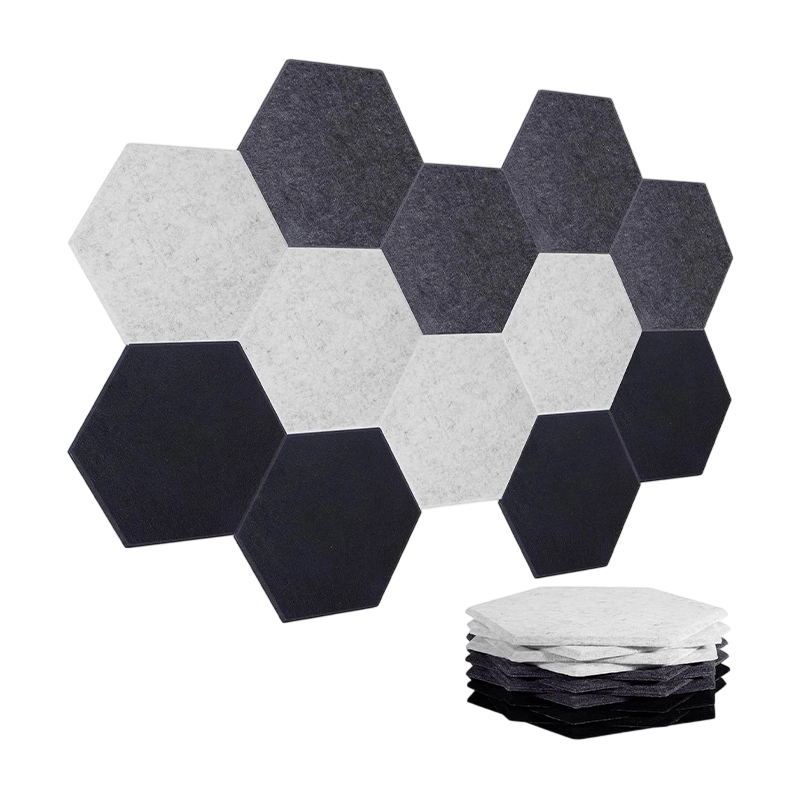

Hexagonal Multi-Color Combination Polyester Fiber Acoustic Panel
-
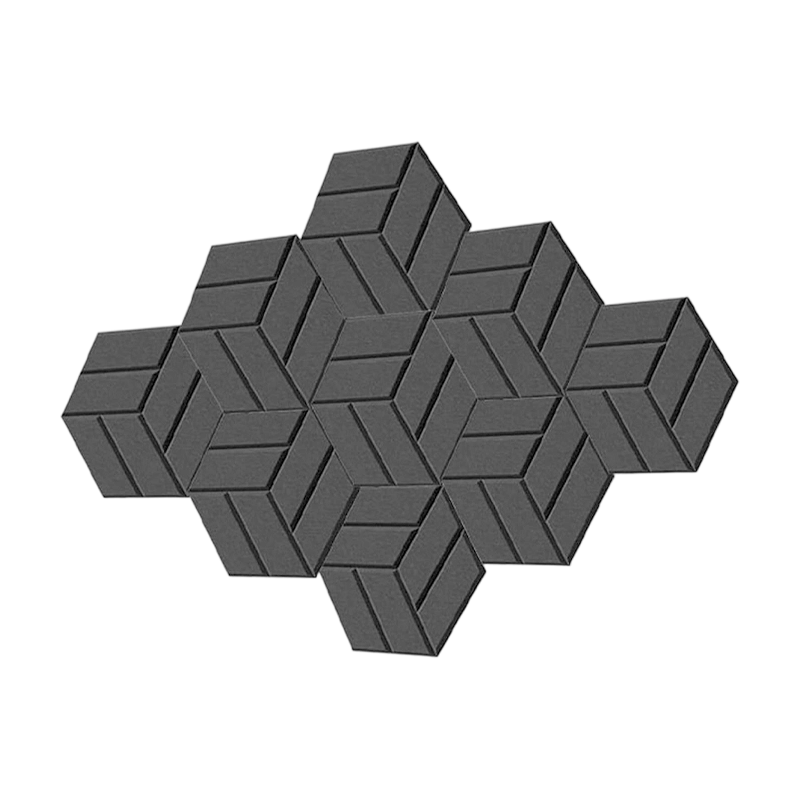
Single-Color Hexagonal Polyester Fiber Acoustic Panel
Special-shaped acoustic panels are precision cut by CNC waterjet and routing technology into hexagons, circles, triangles, and bespoke geometric forms. This production process ensures clean edges and dimensional consistency across high-volume runs, allowing designers to specify modular pattern systems with confidence.
Beyond the visual impact, each piece retains the full acoustic performance of polyester fiber: effective broadband sound absorption, Class B fire rating, and lightweight construction that simplifies ceiling and wall mounting. Panels can be arranged in single-tone or mixed-color compositions.
Custom shapes and color combinations are available for OEM and project-specific orders.
Changshu Chiheng Decorative Materials Co., Ltd.
We are a professional manufacturer specializing in polyester fiber acoustic materials, dedicated to providing effective, safe, and sustainable sound control solutions for architectural and interior spaces.
With a modern production base covering 20,000 square meters, as Special-Shaped Acoustic Panels Suppliers in China, we focus on the development and manufacturing of polyester fiber acoustic panels and sound-absorbing materials, offering over 2 product series and more than 1,000 models to meet diverse project requirements worldwide.
- Factory Area
20000㎡
- Annual production capacity
1000000+
- Annual Export Ratio
90%
- Product Model
1000$

Core Production & Quality Control
Our 20,000 m² modern manufacturing facility specializes in polyester fiber acoustic panels and acoustic insulation materials. We are Custom Special-Shaped Acoustic Panels Manufacturers in China, Supply Custom Special-Shaped Acoustic Panels. We use high-quality polyester fibers, ensuring purity, consistency, and long-term stability from the source. Production and testing are carried out in accordance with international standards, with close attention to acoustic performance, safety, and environmental indicators.
News
-
Two tone sound-absorbing panels combine acoustic performance with distinctive visual design, offering a way to control noise while making a deliberate...
View More -
Self-adhesive fiber acoustic panels have simplified the process of soundproofing and noise control for homeowners, renters, and businesses alike. Unli...
View More -
Polyester fiber acoustic panels have become one of the most practical solutions for controlling noise and improving sound quality in both residential ...
View More
Industry knowledge
Why Curved and Irregular Geometries Change the Acoustic Calculation
Flat rectangular panels are relatively easy to predict acoustically because their absorption coefficients are measured and published under standardized flat-panel test conditions. Once a surface curves, tapers, or breaks into an irregular polygon — a wave-form ceiling cloud, a cone-shaped column wrap, a diamond-cut feature wall, or a custom logo silhouette — the relationship between surface area, edge exposure, and airflow around the panel no longer matches the flat-panel model. Curved surfaces increase the effective edge length relative to their footprint, and edges are where a porous absorber like polyester fiber does a disproportionate amount of its work, since sound waves passing along an exposed edge interact with the fiber structure from multiple angles rather than a single perpendicular incidence. This is one of the reasons a well-designed curved or special-shaped panel can sometimes outperform a flat panel of the same square footage in real-room measurements, even though the published NRC for the flat material is identical. It is also why shape should be treated as an acoustic variable during design, not purely a decorative decision made after the acoustic package has already been specified.
Structural Considerations That Differ From Standard Panels
Cutting a panel into a non-rectangular shape changes how stress is distributed across the board, particularly at narrow points, sharp inside corners, and cantilevered sections that extend beyond a mounting bracket. A standard flat panel relies on evenly distributed edge support, but a star-shaped or asymmetric panel may have long unsupported spans on one side and almost no material on another. Manufacturers producing special-shaped acoustic panels need to account for this during the die-cutting or CNC-routing stage by reinforcing thin sections, adjusting fiber density locally, or specifying a minimum material thickness that the design might otherwise ignore for the sake of a cleaner silhouette. Skipping this step is a common cause of warping or edge chipping in field installations, especially in panels shipped to sites with different humidity conditions than the factory environment.
Production Methods Behind Custom Shapes
There are three production approaches commonly used to create non-standard panel geometries, and each comes with different tolerances, lead times, and cost implications for a project.
- CNC routing from flat stock: the most flexible and cost-effective method for two-dimensional shapes such as stars, waves, hexagons, or custom logos, with tight dimensional tolerance suitable for tiled installations.
- Thermoforming or hot-press molding: used for genuinely three-dimensional forms like curved ceiling clouds or column wraps, where the polyester fiber is heat-pressed into a mold rather than cut from flat sheet.
- Segmented assembly: complex forms too large or too curved for a single mold are built from smaller flat or lightly curved segments joined on site, trading some visual seamlessness for much lower tooling cost and easier shipping.
Choosing between these methods usually comes down to order volume and geometry complexity. A one-off lobby installation with a single dramatic curved form often justifies a custom mold, while a repeated modular shape across many rooms is typically more economical through CNC routing of a standard flat panel. Changshu Chiheng Special-Shaped Acoustic Panels are produced using both routing and molding processes depending on the project brief, which allows a single order to combine tiled geometric elements with a small number of fully custom-formed pieces without switching suppliers mid-project.
Typical Tolerance and Lead Time by Method
| Production Method | Dimensional Tolerance | Typical Lead Time | Best For |
| CNC routing | ±0.5mm | Short | Flat geometric and repeated shapes |
| Hot-press molding | ±1.5mm | Longer, tooling required | Curved or 3D forms |
| Segmented assembly | Varies by joint method | Moderate | Large-scale complex forms |
Mounting Hardware Is Where Most Custom-Shape Projects Go Wrong
Standard rectangular panels are usually installed with predictable hardware — Z-clips along straight top and bottom edges, or a batten grid sized to a fixed module. Special-shaped panels rarely fit this pattern cleanly, since a wave-form or star-shaped panel may not have a single straight edge long enough to anchor a standard clip run. Installers who are not briefed on this in advance sometimes attempt to force standard hardware onto an irregular shape, which results in visible fasteners, uneven gaps between the panel and the wall, or, in worse cases, a panel that is under-supported at its heaviest point and sags over time. The more reliable approach is to design the mounting points during the shape design phase itself, identifying structurally sound anchor locations on the back of the panel before the cutting or molding process begins, rather than treating hardware selection as a downstream installation problem.
Questions Worth Asking a Supplier Before Ordering Custom Shapes
- Will the panel ship as a single piece or require on-site assembly, and if segmented, how are the joints finished and hidden?
- What is the minimum unsupported span the shape allows before additional backing or reinforcement is required?
- Does the acoustic rating provided apply to the shaped panel as tested, or is it extrapolated from flat-panel test data?
- What tolerance is guaranteed for repeated shapes across a large order, since even small deviations become visible when many identical custom pieces are installed side by side?
Where Custom Geometry Adds Real Functional Value, Not Just Visual Interest
It is worth separating projects where a special shape is purely decorative from projects where the geometry solves an actual acoustic or spatial problem. In recording studios and broadcast rooms, angled or faceted panel arrangements are often used specifically to break up parallel wall reflections that cause flutter echo, meaning the irregular shape is functionally necessary rather than aesthetic. In open-plan offices, cloud-shaped or cluster-hung ceiling panels can be positioned directly above specific noise sources — a bank of desks, a meeting pod, a call-center zone — in a way that a uniform grid of rectangular panels cannot achieve, since the shape allows the coverage to follow the actual noise-generating area rather than the room's structural grid. Retail and hospitality projects tend to use custom shapes for brand expression, incorporating a logo outline or a signature curve into the ceiling or wall design, which still requires the same acoustic engineering discipline behind it even though the primary driver is visual identity.
Changshu Chiheng Decorative Materials Co., Ltd. approaches special-shaped panel projects from this dual perspective, treating each custom form as both a design element and an acoustic component that needs to meet a measurable target. Operating from a 20,000-square-meter production base and maintaining more than 1,000 models across our polyester fiber acoustic product lines, the company works with project teams from the concept sketch stage through to final installation drawings, which allows structural reinforcement, mounting strategy, and acoustic performance to be resolved together rather than as separate conversations after a shape has already been finalized. For architects and acoustic consultants exploring Special-Shaped Acoustic Panels for a project with an unusual ceiling profile or a branded interior element, the practical takeaway is to bring the shape into the acoustic conversation early — the geometry, the mounting method, and the sound-absorption target all depend on decisions made at the same stage of the design process, not in sequence.
-
QUICK
Home Products About Projects News Contact -
Product Categories
Polyester Fiber Acoustic Panels Custom Acoustic Panels Self-Adhesive Acoustic Solutions Composite Sound Absorber Acoustic Accessory & Whole Solutions Special-Shaped Acoustic Panels -
Contact
 cwl13092627852@163.com
  +86-13092627852 +8613913783502
 No. 6 Youpin North Road, Zhitang Town, Changshu City, Suzhou, Jiangsu Province, China
Let’S Co-Create A High-Quality Future For Decorative materials.
We are committed to providing you with cutting-edge design, more efficient delivery, and more stable quality solutions,Meet your material needs.
Copyright © 2026 by Changshu Chiheng Decorative Materials Co., Ltd. Rights Reserved.
