
 English
 عربى
عربى
Wholesale PVC Soundproof Board


PVC Soundproof Board Manufacturers
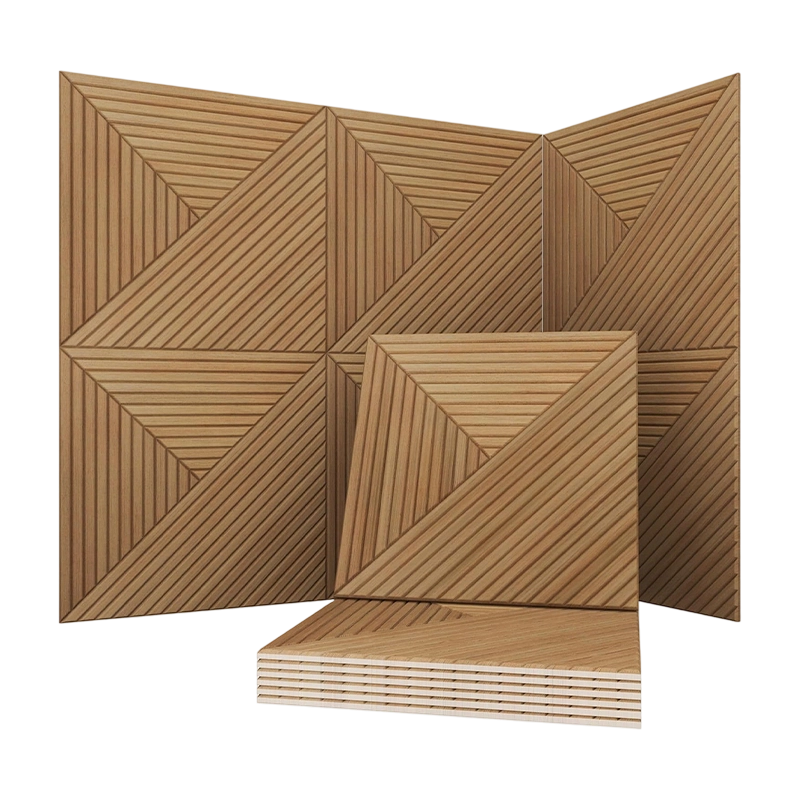

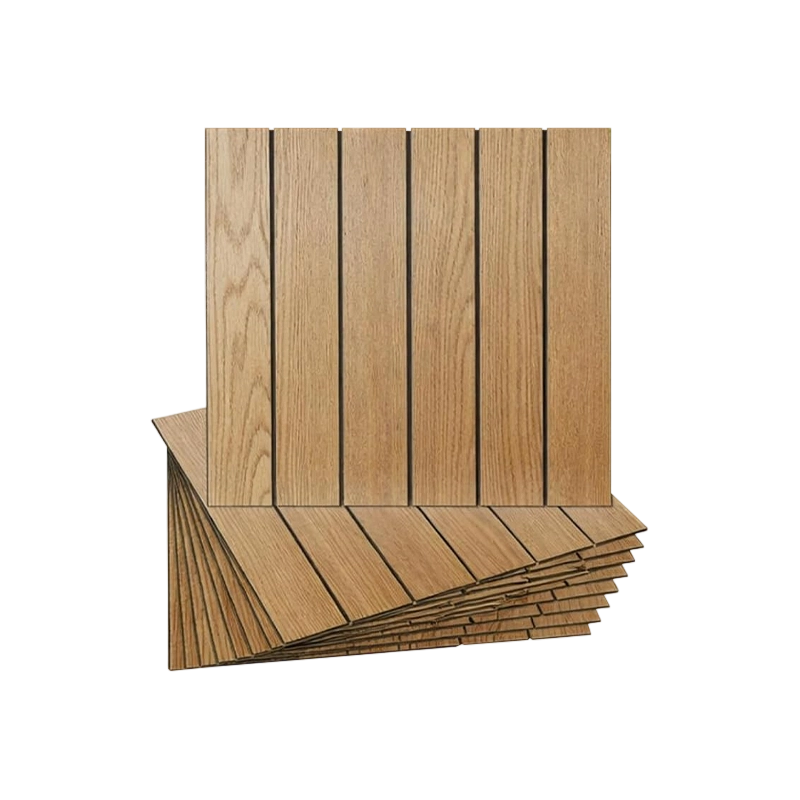
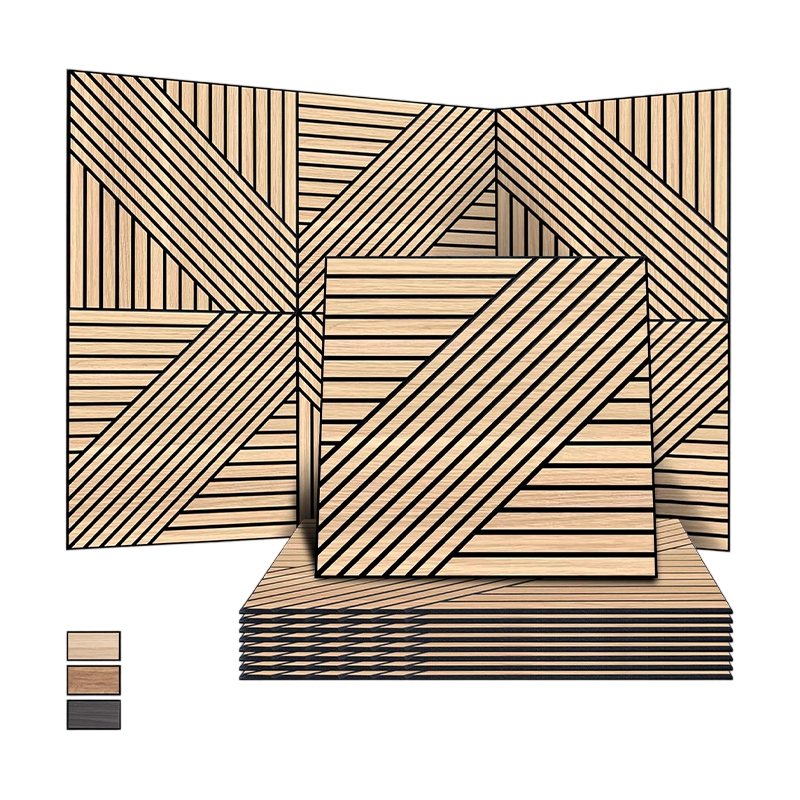
PVC composite acoustic panels bond a high-density polyester fiber acoustic core to a PVC wood-grain decorative surface layer. The PVC face provides a natural timber appearance with practical advantages: resistance to surface moisture, abrasion, and everyday wear — making this panel suitable for commercial environments where both acoustic performance and surface durability are priorities.
The panel absorbs broadband sound through the polyester fiber substrate while the PVC surface layer adds a level of structural surface protection not available in standard fiber-only panels. The result is a clean, natural-looking finish that requires minimal maintenance.
Available in multiple wood-grain patterns and panel dimensions; OEM production with custom surface designs is supported.
Changshu Chiheng Decorative Materials Co., Ltd.
We are a professional manufacturer specializing in polyester fiber acoustic materials, dedicated to providing effective, safe, and sustainable sound control solutions for architectural and interior spaces.
With a modern production base covering 20,000 square meters, as PVC Soundproof Board Suppliers in China, we focus on the development and manufacturing of polyester fiber acoustic panels and sound-absorbing materials, offering over 2 product series and more than 1,000 models to meet diverse project requirements worldwide.
- Factory Area
20000㎡
- Annual production capacity
1000000+
- Annual Export Ratio
90%
- Product Model
1000$

Core Production & Quality Control
Our 20,000 m² modern manufacturing facility specializes in polyester fiber acoustic panels and acoustic insulation materials. We are PVC Soundproof Board Manufacturers in China, Supply PVC Soundproof Board Wholesale. We use high-quality polyester fibers, ensuring purity, consistency, and long-term stability from the source. Production and testing are carried out in accordance with international standards, with close attention to acoustic performance, safety, and environmental indicators.
News
-
Two tone sound-absorbing panels combine acoustic performance with distinctive visual design, offering a way to control noise while making a deliberate...
View More -
Self-adhesive fiber acoustic panels have simplified the process of soundproofing and noise control for homeowners, renters, and businesses alike. Unli...
View More -
Polyester fiber acoustic panels have become one of the most practical solutions for controlling noise and improving sound quality in both residential ...
View More
Industry knowledge
Sound Blocking Versus Sound Absorption: Why PVC Boards Solve a Different Problem
A PVC soundproof board and a porous acoustic panel are frequently discussed as if they compete for the same purpose, but they actually address two distinct acoustic problems that are often confused by non-specialists. A PVC soundproof board works primarily through mass and density to block or reduce sound transmission from one side of a barrier to the other — this is the property engineers refer to as sound transmission loss, measured through a Sound Transmission Class (STC) rating. Porous absorptive materials, including polyester fiber panels, work through a completely different mechanism: they reduce sound energy reflecting around within a room, improving speech clarity and reducing reverberation, but they do very little to stop sound from passing through a wall or partition to an adjacent space. This distinction matters enormously for correct product selection. A partition wall between a mechanical room and an office needs a high-mass barrier material like PVC or a similar dense composite to actually reduce noise transfer, while a conference room struggling with echo and poor speech intelligibility needs a porous absorber instead, since adding more mass to the walls would do nothing to solve an internal reverberation problem.
Choosing Based on the Actual Noise Problem
| Problem Type | Correct Material Category | Key Rating to Check |
| Sound leaking between rooms | Mass-based barrier (PVC board, dense composite) | STC (Sound Transmission Class) |
| Echo or poor speech clarity within a room | Porous absorber (polyester fiber panel) | NRC (Noise Reduction Coefficient) |
| Both problems present at once | Combined barrier-plus-absorber assembly | Both STC and NRC evaluated together |
Where PVC Soundproof Board Performs Well and Where It Falls Short
PVC soundproof board earns its place in specific project types because of practical properties beyond acoustics alone. It resists moisture far better than fiber-based materials, making it a reasonable choice for machine rooms, basements, parking structure partitions, and industrial environments with regular washdown or high humidity exposure. It is also relatively easy to clean and holds up to repeated impact better than lightweight fiber boards, which is useful in areas where equipment or carts may bump against a partition wall. However, its acoustic limitations become apparent quickly once a project requires anything beyond basic transmission blocking. Because PVC is a dense, largely non-porous material, it reflects sound rather than absorbing it, meaning a room lined entirely in PVC board will actually sound harsher and more reverberant than an untreated room in some cases, since the reflective surface adds to the internal sound buildup rather than reducing it. This is why PVC soundproof board is rarely specified as a standalone finish in occupied rooms and is more commonly used as a structural barrier layer within a wall assembly, hidden behind a finished interior surface rather than left exposed as the room's acoustic treatment.
Practical Limitations to Account for During Specification
- PVC board alone does little to reduce reverberation within the room it is installed in, since it lacks the porous structure needed for absorption.
- Its rigidity means it transmits low-frequency structure-borne vibration more readily than a mass-spring-mass wall assembly designed specifically for vibration isolation.
- Thermal expansion in PVC is higher than in wood-based or fiber materials, which can cause visible warping in boards exposed to significant temperature swings if not properly fixed with expansion allowance.
- Fire performance varies significantly between PVC formulations, so confirming the specific fire rating of a given board — rather than assuming all PVC products meet the same class — is essential for code compliance.
Building a Complete Acoustic Assembly: Combining Barrier and Absorber Layers
Most real-world acoustic problems in commercial and institutional buildings involve both transmission loss and internal reverberation simultaneously, which means the most effective solution is often not choosing between PVC soundproof board and a porous absorptive panel, but layering them correctly within the same wall or partition assembly. A common approach places a dense PVC or composite barrier layer within the wall cavity or as a base layer to control sound transfer between spaces, with a porous polyester fiber acoustic panel finishing the room-facing surface to manage internal reflections and speech clarity. This layered approach lets each material do the job it is actually engineered for, rather than expecting a single product to solve two fundamentally different acoustic problems. Getting the sequence right matters — placing the absorptive layer facing into the occupied room, with the denser barrier layer positioned to block transmission through the structure, produces measurably better results than reversing the order or relying on either material alone.
Changshu Chiheng PVC Soundproof Board is offered by Changshu Chiheng Decorative Materials Co., Ltd. as part of a broader product range that pairs barrier materials with our core specialty in polyester fiber acoustic panels, allowing project teams to specify a complete wall or partition assembly rather than sourcing barrier and absorptive components from separate suppliers with inconsistent documentation. Operating from a 20,000-square-meter production base with more than 1,000 models across our acoustic product lines, the company works with architects and contractors to identify whether a given space needs transmission control, internal absorption, or both, before recommending a specific PVC Soundproof Board and panel combination suited to the project's actual acoustic requirements.
-
QUICK
Home Products About Projects News Contact -
Product Categories
Polyester Fiber Acoustic Panels Custom Acoustic Panels Self-Adhesive Acoustic Solutions Composite Sound Absorber Acoustic Accessory & Whole Solutions PVC Soundproof Board -
Contact
 cwl13092627852@163.com
  +86-13092627852 +8613913783502
 No. 6 Youpin North Road, Zhitang Town, Changshu City, Suzhou, Jiangsu Province, China
Let’S Co-Create A High-Quality Future For Decorative materials.
We are committed to providing you with cutting-edge design, more efficient delivery, and more stable quality solutions,Meet your material needs.
Copyright © 2026 by Changshu Chiheng Decorative Materials Co., Ltd. Rights Reserved.
